
Pin What?

While doing some research for my post about quilt borders, I read something that changed my {quilting} life.  It is a page of tips for quilt borders by Bonnie Hunter of Quiltville (probably best known to modern quilters for her Scrappy Trip Around the World tutorial). Her tips are extremely helpful for getting borders right, but it’s the part she wrote about easing in fullness that clicked for me:

Sew your borders to the long sides of the quilt first, pinning the centers and the ends and easing where necessary. If the border seems bigger than the quilt top, stitch the border to the quilt with the border against the feed dogs. If the quilt seems a bit bigger, then sew that on with the quilt next to the feed dogs to ease it in a bit.   {Border Hints and Tricks by Bonnie Hunter}

Basically, she’s saying that the fabric next to the feed dogs gets eased in when you sew…I don’t know about you, but I’ve always been a half-assedhearted pinner. I pin to match points, but when I’m sewing straight edge to straight edge, I just line up the ends and go. Often, though, I get to the end and my pieces are a hair of a fraction of an inch out of whack. It’s not a lot, but it drives me crazy. I know I just squared that block up to a perfect 12.5″ and I know that sashing piece is cut to precisely 12.5″ so WTF? (My sweet niece Emma thinks that stands for Where’s the Fun?)

Well, now I know WTF the problem is – that damn easing in!

With Bonnie’s words on my mind, yesterday I pinned every single seam on a quilt top I was piecing, points or not. And guess what? Zero out of whack ends. All matched. All perfect. Like a pro.

I have seen the light.

Learn to Quilt: Piecing Part 2

This post is part of my Learn to Quilt series. You can find all related posts {here}.

Learn to Quilt: Piecing

Today I’m back (finally!) finishing up Part 2 of piecing your quilt top. The pattern we are using has excellent instructions on putting together the rows, but I’d like to add a few tips to get your points perfectly matched. I’ll also go through the steps for adding borders. This post is long so grab a snack and hunker down.

MATCHING POINTS

1. Square up your blocks (in this case, rectangle up your blocks!) before you start piecing the top. Blocks should measure 12 1/2″ x 8 1/2″ with seams. Normally I’d use a quilting square that measures the same size (or close to) the size of my unfinished block. Since these blocks are rectangular, I used my 6″x24″ ruler to square them up. To do this, use the seam as your measuring point…our 2.5″ strips are now 2.25″ wide since we’ve sewn one seam:

VMQ-LearntoQuilt-squareup

Set your ruler so that the 2 1/4″ mark falls on the seam. The right edge of the ruler should be just about even with the edge of your block. Trim off any excess.

VMQ-LearntoQuilt-trim

Flip your block clockwise to the next seam and repeat. Do this for all four sides.

Squaring up is tedious and it can be a major PITA. But don’t skip it. It can make a big difference in the final product. Make it a part of your process to square up at every step of piecing – smaller block units and the final block.

2. When joining blocks or block segments where your seams will meet up, PIN! Use Clover fork pins and make those seams match. Sometimes you will have to gently stretch the fabric to make your points match. In the photo below, you can see my two blocks pinned together, with the seams pressed in opposite directions.

Learn to Quilt: Piecing

3. Thoroughly press every seam. I press from the top because I get a flatter seam that way, but if pressing from the back works for you, do that. Use a bit of starch and a HOT iron.

ADDING BORDERS

Borders are the red-headed step child of the modern quilting world. Dated, grandma-ish…they are just uncool to most modern quilters. I don’t often add borders, but sometimes they’re nice to frame the piecing. I also add borders in a situation like this quilt top where the points on my blocks would be covered by the binding if I went border-less. To modernize the borders on this quilt, I’m using the same color for both and it’s meant to act more as a background than a frame. The piecing will look like it’s floating.

Now that we’ve covered Quilt Border Philosophy 101, let’s talk about how you add them. You could just cut fabric a little bit longer than the side of your quilt and lop off the extra. The quilt police will come and arrest you for that, though, so watch out. Our quilt top has two borders – an inner one pieced like a block and the outer one that is a typical border. Piece your inner border according to the pattern instructions and then come back here for your outer border.

The proper method for adding borders is:

1. Get out that calculator and do some math. The formulas are simple:

Finished Block Height x No. of Vertical Blocks + Inner Border Width = Quilt Top Height
8″ x 8 + 2 1/4″ = 66 1/4″ (Note that at this stage our inner border still has one unfinished seams so we need to keep that measurement at 2 1/4″ instead of the finished size of 2″.)

Finished Block Width x No. of Vertical Blocks + Inner Border Width = Quilt Top Width
12″ x 5 + 2 1/4″ = 62 1/4″ (Again, we are keeping that unfinished 1/4″ seam in the calculation)

(Quilt Top Height x 2) + (Quilt Top Width x 2)  + (Semi-Finished Border Width x 4) = Total Border Length
(66 1/4″ x 2) + (62 1/4″ x 2) + (6.25″ x 4) = 282 inches

If this makes your head explode, use a quilting calculator. They’ll do all of that math for you, but you’ll still have to measure/calculate the height and width of your quilt top. Calculations are more accurate than measuring, but if you’d rather get out the yard stick, measure from the center of the quilt top, not the edges.

2. Prep your border fabric. Cut WOF x width of your desired border. Our border is 6 1/2″ wide and we need 282 total inches + seams. Let’s do one more calculation:

Total Border Length/Useable Fabric Width = Number of Strips to Cut + Overage for Seams
282/43 = 6.55

Round up and cut 7 strips WOF x 6.5″.

3. Trim off the selvedges (you can do this before you cut the strips) and sew your border strips end-to-end. You’ll have a total length of about 301 inches.

4. Cut your side border strips to your calculated quilt height from step 1 – 66 1/4″. Sew these on to your quilt top sides.

5. Cut your top and bottom border strips to calculated quilt width from step 1 (62 1/4″) plus border width we just added (6 1/4″) times two – 74 3/4″.

Why all the fuss about borders? You can add a lot of bulk to your quilt top if you attach borders using the “lop off” method (Exihibit A, B, and C). Notice that all of those examples are on long arms….wavy/bulky/bacon-y borders are at their worst on a long arm. The rollers on the long arm pull the fabric taut so any flaws are magnified. A good long arm quilter can work in the fullness but they will probably say ugly cuss words about you while they’re doing it.

Border bulk is not as bad when you are basting the old-fashioned way at home because you can smooth and stretch the fullness out as you baste. But proceed with caution, because that stretching and smoothing may show up in the final quilt as wonky edges or a quilt that you have to trim down excessively to hide the imperfections. As my Mamaw (and probably lots of people’s mamaws) would say, you can’t make a silk purse out of a pig’s ear.  It’s easier to do it properly than to fix a wonky, wavy mess.

See you next Monday for part 8 – Learn to Quilt: Basting.

Tip: HST Marking

VMQ-hst-marking

A few weeks ago I shared a tip for piecing half square triangles (HSTs) without marking. I have another time-saving tip today, this time for marking HSTs or snowball corners…or almost anything you need to mark for accurate piecing.

You will need: a tracing wheel, a ruler, and transfer paper.

Set your pieces for marking right side up on top of your transfer paper. To mark three at once, I lined my pieces up point to point.

Line the ruler edge up along the diagonal of your pieces. Run the tracing wheel along the edge of the ruler.

That’s it. Perfect marks!

HST-marking-1-3

It saved me a lot of time doing three pieces at once versus the old-school marking with a pencil method. Plus I think the tracing wheel works better – it doesn’t catch the way a pencil sometimes can.

Time

Love his smile so much!

Time…there is never enough of it. I have a lot of things on my to-do list at the moment, but I’m having trouble focusing. Tonight I  decided that some decluttering around the house and especially my sewing room would help. I went solid for an hour and then decided that I need professional help (not mental help but in the form of a professional organizer…maybe mental help for the fabric hoarding). So I spent five minutes Googling professional organizers in Dallas and then an ad for fabric caught my eye on the edge of the browser window. Click. Drool. Click. Click. Click. I spent thirty minutes browsing the sale section at one of my favorite online fabric shops. Moral of this story? The internet is evil.

New fabric goodies. Too bad you can't buy time to quilt, too.

Focus is actually my one little word for 2013 and so far it has motivated me to stop spending so much time doing nothing.  2012 was consumed by new baby things and as all mothers know, it is overwhelming to be responsible for a tiny and precious and delicate thing. Leaving the corporate world also had a huge impact on me. I felt untethered and the freedom of it was both exhilarating and a little bit frightening. Honestly, now I laugh with pure, unadulterated joy when I drive by the old office where I used to work. It’s a crazy laugh like a child hopped up on birthday cake who just opened a Malibu Barbie dream house.

testing

I spent most of 2012 feeling adrift, not quite sure what to do with my new-found freedom and my new baby responsibility. So I did a lot of nothing. I didn’t sew very much, I didn’t blog very much. I watched TV and shopped and did so much nothing that I was just sick with boredom. After Ben turned one and was weaned, I got a little breather and I realized that I could do a lot of wonderful things instead of so much nothing. So I did.

Pre-washing apparel fabric. I'll have lots of cute stuff to wear this summer

People ask me a lot how I find the time or the energy to do all of the different things that I do. The truth is, we all have the same amount of time. I’ve made a decision to not waste mine so that means I rarely do things like watching TV. I don’t go to parties or events out of a sense of obligation. My time is mine and there is not a lot of it, so I only do things that make me happy. I’m selfish with it..  I spend as little time as possible doing the chores and tasks that have to be done to run a household.  Even though I love to cook, I don’t love having to cook to feed people so I cook and freeze four or six weeks worth of food at a time. Every time I defrost a casserole or pasta sauce, it’s like a little gift to myself. Bills are on autopay, my husband does 90% of the laundry and a hefty share of childcare, and things do slip through the cracks. Our house is not as clean as my Aunt Irma’s where you could literally eat off the floor (cause she just mopped it) but I’m okay with that.

DSC_0293_c

In this season of my life, I am being selfish as much as possible and I think more young moms should try it. You only get one shot at life so build a life that makes you happy.

Stars and 4-Patches

Stars and 4-Patches

This quilt makes me happy! The bright, modern colors juxtaposed against the traditional pattern make my heart go pitter patter. It’s very Vintage Modern, don’t you think? The pattern is from Moda Fabrics and is part of their collection of 12-pack patterns. Each pattern is designed to use 12 fat quarters. The patterns are exclusive to quilt shops so give your local shop a call for more info.

Stars and 4-Patches

I used {this bundle} of Bella Solids for my 12 colors. The white in the background is Feather (9900-127) and I love working with it. It’s got a bit more gray than the other whites. Here’s a shot of the Bella whites together for comparison:

bella solids...whites.

This was quilted for me by Michelle Kitto of Urban  Spools. She did a beautiful job!

Stars and 4-Patches

Stars and 4-Patches

Love it. So. So. Much.

Dimensions: 72″ x  72″

Fabrics: Bella Solids by Moda Fabrics, – Pale Pink | 9900-26, Sisters Pink | 9900-145, Pink | 9900-9900-61, Popsicle | 9900-143, Citrine | 9900-211, Pesto| 9900-233, Gray | 9900-83, Stone | 9900-128, Betty’s Brown | 9900-125, Robin’s Egg | 9900-85, Seafoam | 9900-191, Turquoise | 9900-107, Feather | 9900-127

Quilting Thread: Superior Thread, quilted by Michelle Kitto of Urban  Spools

Started: March 2013

Completed: May 2013


Hello, there…

There has been a lot of thinking and writing about sewing happening at my house, but not much actual sewing in the last week. I have a big deadline that has suddenly gotten a whole lot closer because the month of May pretty much vanished from the calendar. It’s almost over, people! How did that happen? So this means I’m postponing the next lesson of my Learn to Quilt series for another week. We left off piecing blocks, which is a good place to be stuck for a a while.  That’s how quilting goes. You usually get stuck at one stage or another.

I’ve been playing around with Adobe Lightroom for this first time this week and I must say that I LOVE IT WITH ALL MY HEART. Much simpler and cleaner than Photoshop. I whipped out about six weeks worth of photos in just a few hours on Sunday night (trying to make the cutoff for a free print deal on Shutterfly). I pulled in some photos I took of my vintage sheet quilt that I thought had turned out total crap and I was able to pretty them up in Lightroom.

DSC_0110.jpg

I took that at the arboretum one Saturday. As I walked up towards that big white rock, a snake slithered out from under it and made my heart drop right into my toes. I screamed (it was a very ladylike scream) and every single hair on my body stood on end (and stayed like that for the next half hour). My husband graciously held the quilt for me instead. Dang snakes. *shudder*

On a Mini Break

Mini Break

My Learn to Quilt series is on a brief hiatus until next week. Toddler sleep regression was kicking my butt the last couple of weeks (that basically means your toddler stops sleeping through the night for no apparent reason) and combined with my own bad habit of staying up LATE, I have been pretty much a zombie. We are visiting my parents in Houston this week for some pool time and really just a break from our routine at home.

I do want to take this opportunity to share Bonnie Hunter’s post about Quilts for Oklahoma. Quilters are such giving people, and for so many families who lost everything in the tornadoes on Monday, a handmade quilt would be an amazing gift. The OKC Modern Quilt Guild is also accepting donations. See their post {here} for the details. Both groups are asking for finished quilts.

Learn to Quilt: Piecing Part 1

This  post is part of my Learn to Quilt series. You can find all related posts {here}.

Civil War Jubilee

Now the fun starts! We’ve learned all about the basics of quilting, and now we are ready to move on to actual sewing. I’ve chosen a free pattern from Moda for this project (shown at left).. You can find the pattern {here}. The sample uses traditional fabrics (Civil War repros) but as soon as I saw it, I knew it would be perfect for more modern fabrics, too. I love the shape of the blocks and the illusion of curves that the piecing creates. The piecing is relatively simple so it’s a great starting point, but it’s also challenging enough that it’s a fun project for a more experienced quilter, too. I was being overly ambitious in trying to work this into two posts so constructing the quilt top will be in two parts – today is cutting and piecing blocks and next Monday I will cover assembling the quilt top and adding borders.

I’m going to use pre-cuts for my version. You have the option of following the pattern exactly as written or going with my changes. To use pre-cuts like me, your fabric requirements are:

1 jelly roll (with 40 strips cut 2.5″ x WOF)
5 fat quarters
1 yd for borders
1/2 yd binding
4 3/8 yds backing

This will yield a 68.5″ x 72.5″ quilt. My quilt will have 40 blocks instead of 45 like the pattern. I’m also going to use the same fabric for both borders. My fabric placement won’t be as rigid as the pattern sample, either. This is partly because I like a more scrappy look, but it also allows us to use fat quarters instead of yardage. My centers will all be solids. Here are the fabrics I’ve chosen:

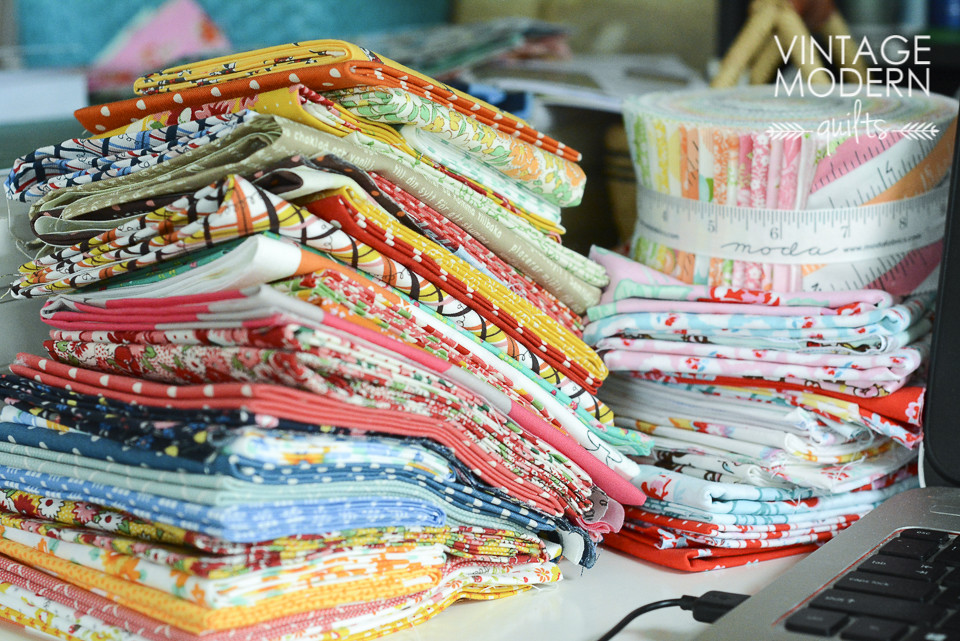
Marmalade Stack

Notice that I have more fat quarters than necessary. This is because I want a wide range of colors for my block centers (plus I had the yardage on hand! Stash-busting is always a good thing.)

CUTTING INSTRUCTIONS

From each jelly roll strip, cut:

2 – 2.5″ x 12.5″ strips
2 – 2.5″ x 4.5″ strips
3 – 2.5″ squares*

*Theoretically, there should be exactly enough width in the jelly roll strip for you to get all of the above cuts. Cut your longer strips first and your 2.5″ squares last. You should easily be able to get 120 squares from your jelly roll strips; cut the rest from your fat quarters. You need a total of 160 2.5″ squares for the quilt.

From eight fat quarters, cut:

6 – 4.5″x8.5″ rectangles
2 – 2.5″ x 18″ strip: subcut into 2.5″ squares for block corners

You will have 8 extra rectangles and 10 extra squares.

CuttingDiagram

Tips for cutting:

  • Use the measurements on your rulers as cutting guides, not the marks on your cutting mat. Rulers are more accurate.
  • Put in a fresh blade if your rotary cutter is catching on the fabric or not cutting all the way through on the first pass. If your blade is relatively new, then make sure you are using firm and even pressure.
  • To prep your fat quarters for cutting, lightly starch and press them. This will make your piecing go smoothly and ensure accuracy.
  • Keep a small bin or bucket on your cutting surface for scraps to toss in the garbage. Keep a separate one for scraps you want to save. Your surface will be neat and you can empty out the buckets when you’re finished exactly where they need to go.
  • Stack your block units together – in order – as you go. For this project, you will have four stacks:Fabric-Stacks

PIECING INSTRUCTIONS

Follow the original pattern to piece your 40 rectangular blocks. The instructions are on page two and three of the PDF file. They are excellent instructions that even include pressing directions. As you are piecing your blocks, keep in mind that your triangle corners won’t match the centers of your blocks like the sample. Here are a few blocks I’ve made:

Marmalade Jubilee

Tips for piecing:

  • Instead of drawing a line from corner to corner on each 2.5″ square, use a paper guide as a stitch line. You line the guide up between the corners and sew next to it, making sure your seam is centered diagonally across your square.
  • Work with an assembly line set up with the block components in tidy stacks next to your machine as shown above. This will allow you to chain piece.
  • Trim your thread ends as you sew to keep things tidy.
  • Lightly starch each finished block and press it.
  • No pinning is required until you assemble the quilt top.

See you next Monday for the continuation of Lesson 7 – Learn to Quilt: Piecing Part 2. We will assemble the quilt top and cut and sew our borders.

Marmalade Jubilee

Little Hands & Toes


Vintage Summer Quilt

Vintage Summer Quilt
I love this quilt. The soft colors…the simple chevron pattern…the pop of the colors against the white background. This quilt makes me happy and it feels summery and beachy. I can see many picnics in its future.

Vintage Summer Quilt

The printed fabrics are vintage sheets purchased on Etsy and cut into 6″ squares to make half square triangles with the white background fabric. The design is simple but graphic. This was quilted by Michella Kitto of Urban Spools on her Handiquilter long-arm. She did a beautiful job and the design really complements the fabric.

Vintage Summer Quilt | Detail

The backing is pieced from a variety of solids and a couple of prints that have that same vintage floral look. You really can’t see any of the solids in my photos, but they are pinks, orange, and yellow.

Vintage Summer Quilt | back

The binding is scrappy, made with leftovers from the backing.

Vintage Summer Quilt | Binding

This is the first quilt I sent off for quilting, and I’m thrilled with the results. I knew it would be beautiful because I’ve admired Michelle’s quilting since I met her, but still…it was my first time not to make the quilt from start to finish so I wondered if I’d feel less ownership over the finished product. But that’s not the case at all. I love that my dear friend is also a part of the quilt.

(Michelle does professional long-arm quilting if you are looking for that service. Email her at michelle{at}urbanspools{dot}com..)

Dimensions: 83″ x 90″

Fabrics: an assortment of vintage sheets, backing is Bella Solids by Moda Fabrics, Uptown by Erin Michael

Quilting Thread: Superior Thread

Started: October 2012

Completed: April 2013

The Learn to Quilt series will pick up again on Tuesday. I took a break today for Mother’s Day instead of piecing a sample block. See you then!

Learn to Quilt: Scrap Management

This  post is part of my Learn to Quilt series. You can find all related posts {here}. Start {here} if you’d like to cover the lessons in order.

I was initially going to write about the quilting community today, but I think I covered that pretty well in Lesson 2: Quilting Definitions and Resources so instead I’ll go over Scrap Management. The more you quilt, the more you will have to deal with scraps so it’s good to have a method in mind. This lesson outlines what I do with my scraps and this may be too much or too little for you given how often you sew. Some people literally save every scrap, and while I do save a lot, I must have order above all else so itty bitty pieces go in the garbage. Be forewarned that there are a lot of steps/processes/tasks in my scrap management system. I’m kind of obsessive that way but don’t let it dissuade you from quilting. You don’t have to be this level of quilting ka-razy.

CUTTING SCRAPS

Most of my scraps come from leftovers from a quilt project. I sort these scraps as a I go:

  • Fat Quarters – When working with yardage, I cut my fabric so that I will have a fat quarter leftover whenever possible.
  • Small, regular scraps | pieces with mostly straight edges that can be used in a project without additional cutting -  I have a bin dedicated to these. Here is a quilt I made with this type of scrap:

Giant Scrappy Blocks | Detail

    • Small, irregular scraps | odd-shaped pieces that would need to be cut for most quilt blocks – These go straight into the bin for my scrappy stars project. They’re perfect to piece together for something like this:Tutorial: Scrapp Stars
    • Strings | long, narrow pieces at least 1″ wide but less than 2.5″ – These go into a big basket under my desk. Strings are usually foundation pieced and string quilts look like this one I recently finished:Red & Aqua | Detail
    • Binding ends | 2.5″ wide by various lengths – I’m working on a scrappy trip around the world quilt (tutorial here) so these are perfect. You could also save these to make scrappy binding.First scrappy trip around block #quilting #scrappytripalong #vintagemodernquilts #retreat
    • Big scraps | smaller than a fat quarter – These go into a bin under my cutting table. It’s easy to sweep them in there while I go. The really big pieces get cut into 2.5″ and 5″ squares at some point (with scraps then going into the different piles listed above). The smaller bits go into a set of Deep ArtBin Containers, sorted by color.

ArtBin 6990AB Super Satchel Double Deep Box with Removable Dividers

LEFTOVER/ORPHAN BLOCKS

There are lots of reasons why you might end up with orphan blocks. Sometimes a block just doesn’t work out. Or you make too many. Or you overdo it when you’re squaring up and that dang thing is too, too small.  You can save them up for projects like potholders, pillows, sampler quilts or you can donate them to the charity committee of your quilt guild like me. Or if you are supremely talented like Anna Maria Horner, you could whip up a series of amazingly beautiful quilts using your orphan blocks. (I was in her Composing a Quilt workshop at QuiltCon and it is hard to believe what that woman can do with leftovers. Imagine what she does with all that turkey that’s left after Thanksgiving?!)

ORPHAN PRE-CUTS

There are usually a handful of charm squares, jelly roll strips, layer cakes, etc. leftover from a project. I throw all of my orphans into my various scrap bins by size. What are they good for? Well, some of the quilts I’ve shown above plus any project that uses those cuts. Don’t be afraid to sew with stuff that doesn’t “match.” We’ll talk about fabric selections in the next lesson.

Scrappy quilts are some of my favorites. Check out my Pinterest board for scrappy quilt ideas. (Looking at scrappy quilts is a great way to help you start thinking about your own scrap management plan.) Do any of you have scrap management tips? How small is too small to keep? Share with us in the comments!

See you next Monday for Lesson 7 – Learn to Quilt: Piecing. We are starting our project! The pace will slow down a bit to just once a week for our last four lessons as we make a quilt from start to finish.